
Hey there, I'm Brian, owner of Proof Construction here in Broken Arrow, OK. If you're reading this, chances are you've just been through a hailstorm, or you're preparing for one (it is Oklahoma, after all!). One of the most common questions I get is, "Brian, what does hail damage on a roof look like?" It's a great question, because often, what you see from the ground isn't the full story. Once you have checked the roof yourself, see hail damage roof repair in Tulsa for what repair actually involves and what it costs.
My team and I inspect storm-damaged roofs across the Tulsa metro area daily. We've seen it all – from subtle dimples that hint at significant issues to obvious impacts that scream "new roof!" This visual guide is designed to help you understand the difference between normal wear and tear and actual hail damage, so you know when it's time to call in the pros.
Why Hail Damage Can Be So Tricky to Spot
Unlike a tree falling on your roof, hail damage isn't always immediately obvious. Here’s why it often goes unnoticed by the untrained eye:
- It's Up High: Most people don't have a safe way to get on their roof, and from the ground, minor damage is practically invisible.
- Color and Texture: Darker or highly textured shingles can camouflage damage better than lighter, smoother ones.
- Angle of Impact: Hail rarely falls perfectly straight down. Angled impacts can cause damage on specific slopes of your roof, leaving others untouched.
- Size Matters (but not always how you think): Even small hail, especially if accompanied by high winds, can cause significant damage, not just the golf-ball sized stuff.
The Tell-Tale Signs: What Does Hail Damage on Asphalt Shingles Look Like?
Most homes in Broken Arrow and the surrounding areas have asphalt shingle roofs. This is where we see the majority of hail damage. Here's what my crew looks for:
1. Granule Loss (Bruising or Dimples)
This is the most common sign. When hail strikes an asphalt shingle, it displaces the protective granules, exposing the underlying asphalt or fiberglass mat. This looks like:
- Circular or Random Dark Spots: These are areas where the granules have been knocked off, revealing the darker asphalt beneath. They often have a circular or "bruised" appearance.
- Soft Spots: If you were to gently press on a hail-damaged area (which you shouldn't do without proper safety gear and training!), it might feel softer than the surrounding shingle. The impact crushes the shingle's core.
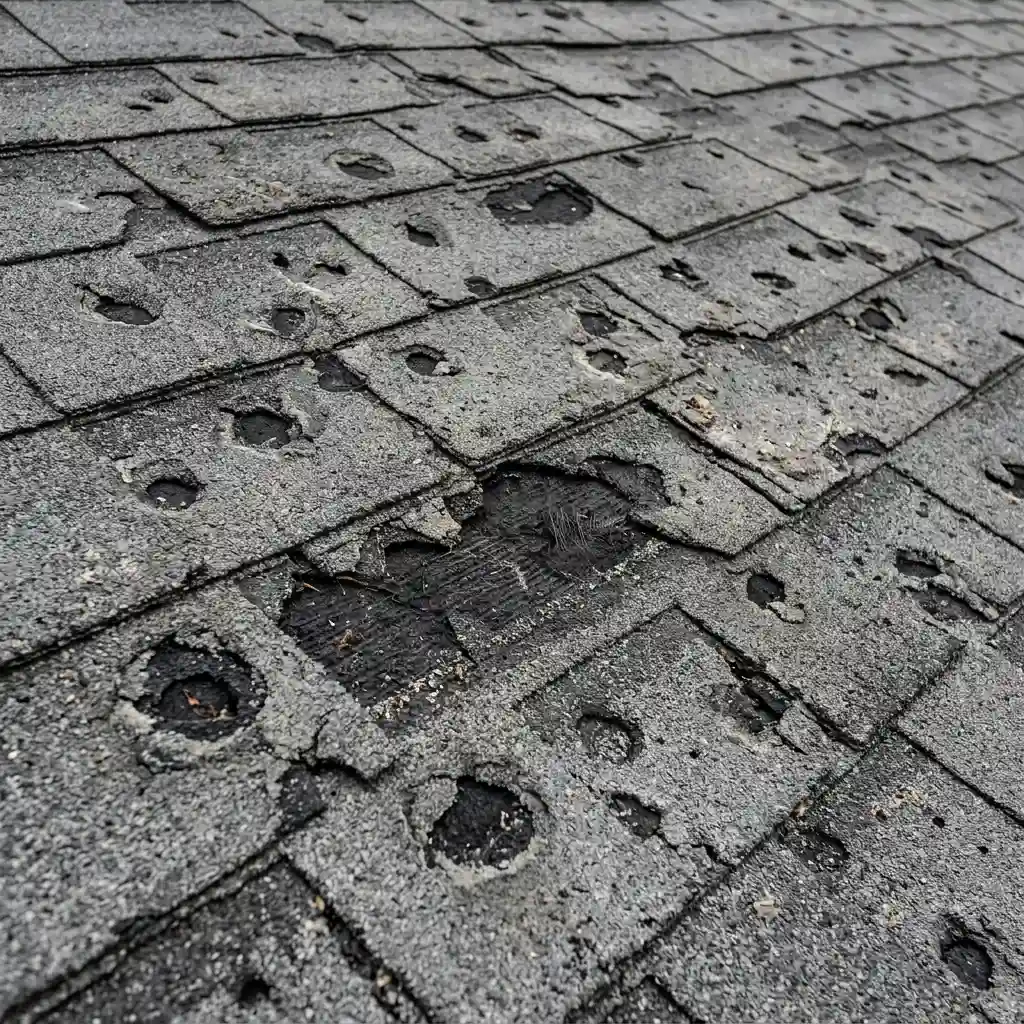 Example: Notice the distinct circular patterns where granules have been dislodged, exposing the black asphalt underneath.
2. Fractures or Cracks
With larger hail or high-velocity impacts, the shingle's fiberglass mat can actually fracture or crack. These aren't always visible from the ground, but up close, you might see:
- "Starburst" Cracks: Small cracks radiating outwards from a central impact point, resembling a star.
- Random Cracks: Unlike age-related cracks which are often linear and follow the shingle's pattern, hail cracks can appear anywhere on the shingle surface.
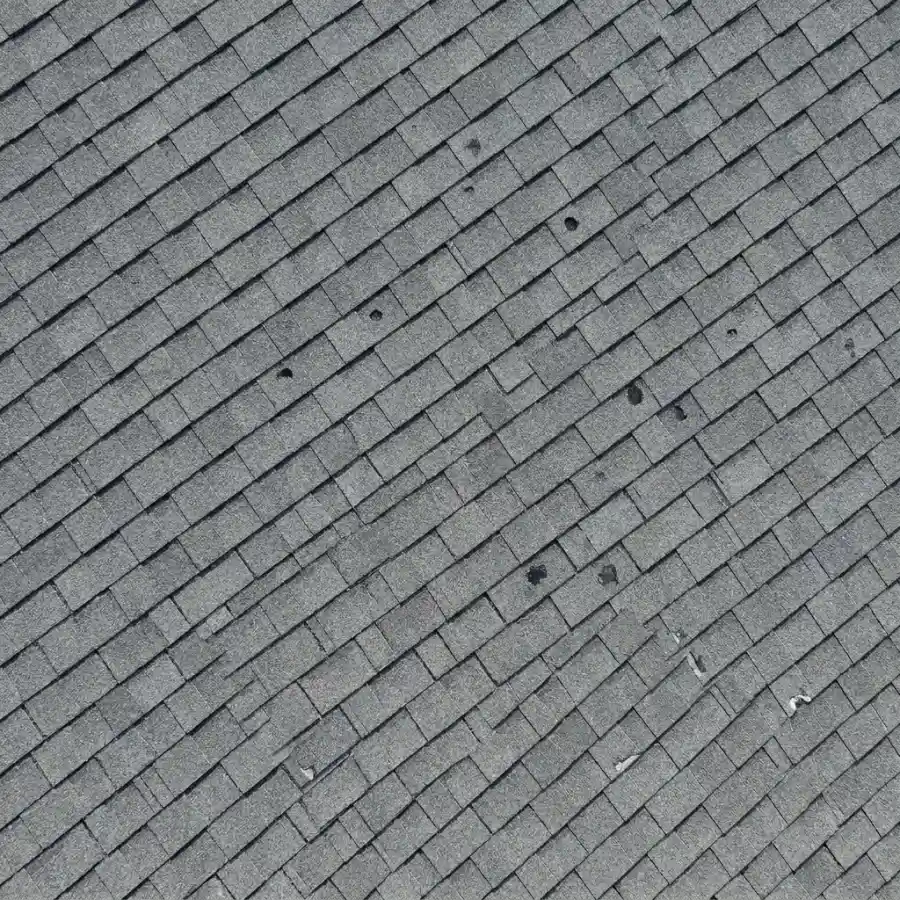
3. Exposed Fiberglass Mat and "Shiners"
When hail strikes hard enough to fracture the shingle, the dark fiberglass mat beneath the asphalt layer becomes visible. Look for small dark streaks or pinhole exposures where the mat shows through — roofers call these "shiners" because the fiberglass catches the light. Unlike granule loss, which is surface-level cosmetic damage, exposed mat means the water barrier itself has been compromised. That shingle is now on a clock: every rainstorm pushes moisture deeper into the mat, and the crack will grow with every freeze-thaw cycle Tulsa winters deliver.
4. Soft Metal Damage: Vents, Gutters, and Flashing
Hail doesn't just hit shingles. Your roof is covered in soft metal — vent caps, pipe boots, chimney flashing, drip edge, and gutters — and aluminum and galvanized steel dent much more easily than asphalt. Check your gutters for dimples, look at your vent caps for creases, and inspect your chimney flashing for folds. Soft-metal damage matters for two reasons: it tells you the storm was severe enough to dent metal (which supports your claim), and it is a separately payable line item on most Oklahoma insurance scopes. Our guide to hail size and damage severity explains how the two connect.
5. Ridge Cap and Seam Splitting
Ridge caps take the most direct hits on a roof because they sit at the highest point, and the nails that hold hip and ridge shingles can drive cracks that split the cap in two. Walk the ridges and hips of your roof (safely, with a partner and proper gear) and look for caps that are cracked down the middle, lifted at the edge, or missing entirely. Split ridge caps are a fast track to leaks because they sit directly over the ridge opening.
How to Check Your Roof Safely From the Ground
You don't need to climb up to learn a lot. From the ground, use binoculars to scan each slope for dark spots, missing shingles, and lifted tabs. Check the ground around your home for granule piles in the gutters and downspout splash blocks — heavy granule loss shows up as sand-like buildup after a storm. Look at your downspouts for dents, and check window screens, AC condenser fins, and car roofs for impact marks. Inside, head to the attic and look for new water stains, daylight through the deck, or granules that have washed down between shingle layers. If anything looks off, that's your cue to book a professional inspection — most Tulsa roofers, including us, inspect for free. Our post-storm inspection checklist walks through the full sweep.
Hail Size vs. Wind: What Actually Damages Roofs
There's a common myth that only golf-ball-sized hail hurts roofs. The truth is that wind-driven smaller hail — penny to quarter size — routinely damages shingles when it arrives at an angle, and even pea-sized hail can bruise a shingle that's already brittle from Oklahoma summer heat. What matters is the combination of size, density, and wind speed at impact, not the size alone. Hail falls at angles, which is why one slope can be destroyed while the opposite slope looks untouched. That variability is exactly why a ground-level glance is never enough. Our guide to telling hail damage from wind damage helps you sort out what your storm actually did.
What to Do After a Hailstorm: The Right Order
If you suspect hail damage, the order of your next steps matters. First, document everything: photograph your roof from every angle, the gutters, the vents, the yard debris, and the storm date from a weather report. Our storm damage photography guide shows what to capture. Second, get a professional inspection — a licensed local roofer who will document damage in writing. Third, file your insurance claim promptly; Oklahoma policies generally require prompt notice, and waiting through the next storm makes damage harder to prove. Fourth, remember Oklahoma's 25% rule: when more than a quarter of your roof is damaged, the policy typically owes a full replacement, not a patch — so make sure the inspection measures every slope. For the full process, see our hail damage repair process and our step-by-step Oklahoma hail claim guide. And when the time comes to re-roof, consider Class 4 impact-resistant shingles so the next hailstorm is a non-event.
Frequently Asked Questions
How soon after a hailstorm should I check my roof?
Check from the ground within a few days, and schedule a professional inspection within a couple of weeks. Don't wait for the next storm — additional damage makes it harder to prove what the first hailstorm caused, and most Oklahoma policies require prompt notice for claims.
Do I need a roofer's inspection before calling my insurance company?
It's strongly recommended. A documented inspection gives you evidence, a written scope, and a basis to compare against the adjuster's estimate. Most Tulsa roofers inspect for free, and it costs nothing to be prepared before the adjuster arrives.
Will hail damage on my roof be covered by insurance?
Hail is a covered peril under standard Oklahoma homeowners policies, but coverage depends on your policy's age, deductible, and claim history. A professional inspection and good documentation are what turn coverage into an actual payout.
What size hail causes roof damage?
There's no hard cutoff. Wind-driven hail of one inch (quarter size) or larger frequently damages asphalt shingles, but smaller hail can bruise aged or sun-baked shingles, especially at high wind speeds. Size alone doesn't determine damage — impact energy does.