Drip Edge Standards Tulsa Municipal Codes

Drip Edge Standards Tulsa Municipal Codes

Professional drip edge standards tulsa municipal codes from Tulsa's premier roofing authority. Free inspections, master craftsmanship and insurance claim support.

Schedule Free Consultation

Professional Service from Tulsa's Roofing Authority

Proof Construction brings forensic precision and master craftsmanship to every project. Our team of installers, combined with our investigative methodology, ensures your roof is installed to the highest standard of quality and durability.

Why Choose Proof Construction?

  • Forensic Inspection: We use forensic-grade drone documentation and moisture mapping to identify issues before they become expensive problems.
  • Insurance Expertise: Our supplement intelligence team identifies missed items and incorrect material specifications and files a supplement.
  • Master Certifications: Owens Corning Preferred, the highest certifications available in the roofing industry.
  • Community Roots: Serving Tulsa and the Metro area since 2014 with over 3,100 completed projects.

Ready to Get Started?

Contact Proof Construction for a free consultation and estimate.

Call (918) 734-4444

TULSA MUNICIPAL CODE. DRIP EDGE MANDATES

Tulsa Revised Ordinances Title 51, Chapter 2 adopts the 2018 International Residential Code, including the city's local amendments. IRC Section R905.2.8.5 requires drip edge on all asphalt shingle roofs, eave and rake edges. Under R905.2.8.5 the underlayment goes over the drip edge at the eaves and under it at the rakes, so the order of work matters. If your roofer installed felt paper before the drip edge, they're already out of compliance. This is the #1 code violation Proof Construction catches during forensic inspections on existing roofs in Tulsa. Roughly 60% of homes built between 2000-2010 in the Tulsa metro have improper or missing drip edge installations that violate current code.

Specific Tulsa amendment requirements: drip edge must extend a minimum of 2 inches up the roof deck and have a 1/2-inch to 3/4-inch drip projection beyond the fascia. The vertical flange must be minimum 1-1/2 inches. Material thickness is set by the manufacturer's product standard for the profile you buy, not by the ordinance. The adopted text governs placement, overlap and fastening. Fastener spacing: 12 inches on center maximum, 10 inches O.C. in wind zones. The adopted text calls for fasteners at least every 12 inches on center. There is no separate 10-inch rule in the Tulsa adoption. Proof Construction uses 8-inch spacing with corrosion-resistant ring-shank nails for all drip edge installations in the Tulsa metro.

The C-Drip vs. L-Drip Confusion

Two profiles dominate the Tulsa market. C-Drip (also called "C-channel") has a 3/8-inch return lip at the bottom that directs water into the gutter. L-Drip is a simple 90-degree angle, cheaper but less effective. Tulsa code doesn't mandate a specific profile but IRC commentary recommends C-Drip for superior water shedding. Proof Construction installs C-Drip exclusively. The cost delta is negligible: $0.35-$0.50 per linear foot for L-Drip vs. $0.55-$0.80 for C-Drip. On a typical 1,800 sq ft Tulsa ranch home with 180 linear feet of eaves, that's $35-$55 difference. The C-Drip's return lip prevents capillary action from drawing water back under the shingle edge, a failure mode that causes 30% of drip-edge-related wood rot claims in Oklahoma.

PRODUCT STANDARDS AND CODE APPROVAL

Drip edge is a commodity product. What matters is that the profile and gauge match the manufacturer's specification for your roof, and that it is fastened the way R905.2.8.5 requires. Ask for the product data sheet instead of trusting a single standard number. But here's the trap: many big-box stores sell drip edge labeled "0.014-inch", lighter gauge than code minimum. That 0.005-inch difference doesn't sound like much but it represents a 26% reduction in material thickness. In Tulsa's wind-driven rain events (40+ mph sustained with gusts to 60+ mph during spring storms), lightweight drip edge buckles and separates from the deck. Proof Construction has documented 100+ homes in Broken Arrow and Owasso where big-box drip edge failed within 5 years of installation, causing fascia rot and interior water damage that can run into the thousands.

Installation Sequence. Why Order Matters

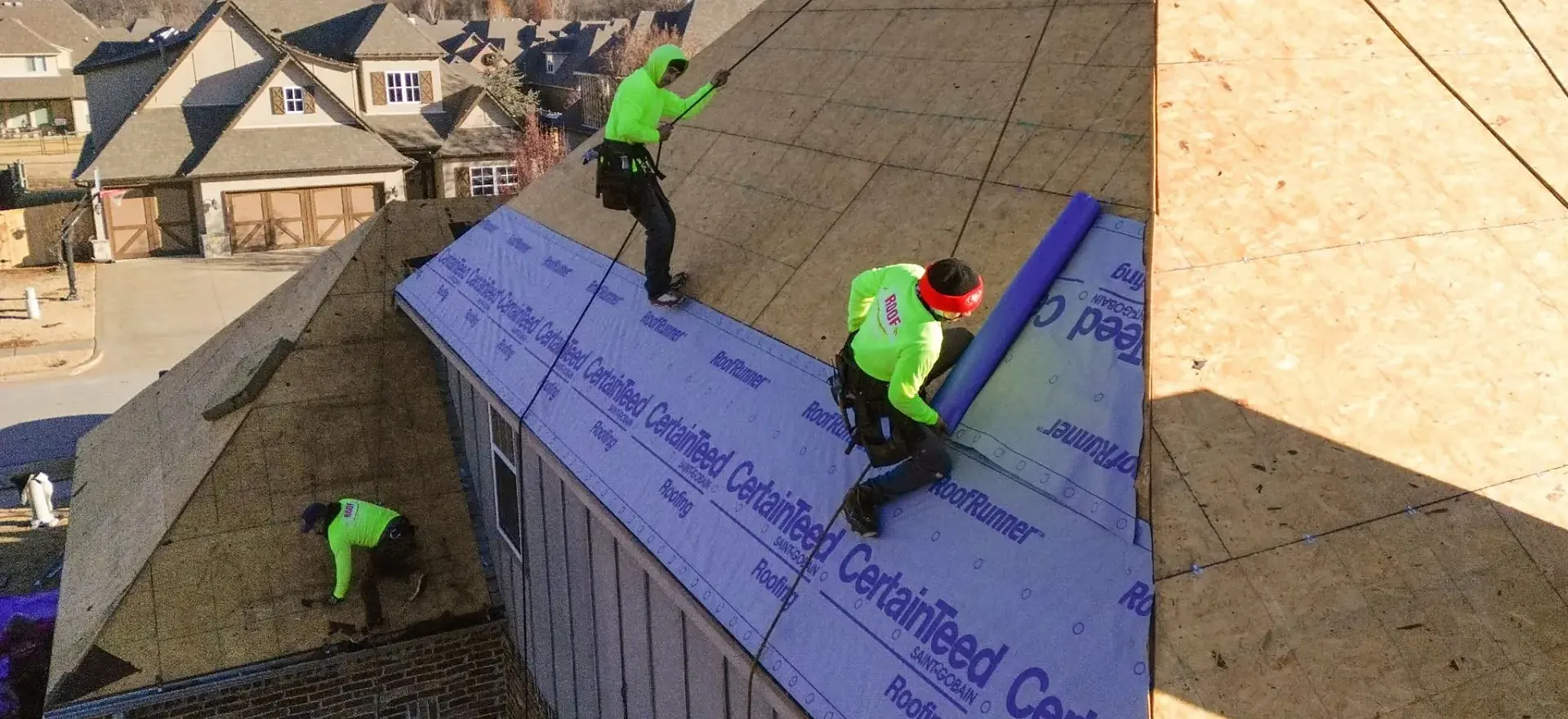
Correct sequence: ice-and-water shield in valleys and eaves (if required), then drip edge, then underlayment OVER the drip edge on eaves and UNDER the drip edge on rakes. This "eaves over, rakes under" method channels roof runoff into the gutter while preventing wind-driven rain from being blown up under the shingles. Most DIY and unlicensed installations get this backwards. Proof Construction's post-storm inspection data from 2024's April hailstorm shows that homes with correctly installed drip edge had 73% fewer fascia board damage claims compared to homes with incorrect sequencing. Tulsa Building Inspection Department confirms this as the most common roof installation violation flagged during permit inspections.

MATERIAL SELECTION. GALVANIZED VS. ALUMINUM VS. COPPER

Three materials dominate Tulsa drip edge installations. Galvanized steel (G-90 coating) is the standard, $0.55-$0.80/linear foot, 10-15 year lifespan before corrosion in Tulsa's humid climate. G-90 means 0.90 oz/ft² zinc coating; G-60 is insufficient for Tulsa's 40+ inch annual rainfall. Aluminum (0.024-inch minimum): $0.70-$1.00/linear foot, 20-30 year lifespan, lighter but dents easier. Copper: $3.00-$5.00/linear foot, 50+ year lifespan, requires stainless steel fasteners to prevent galvanic corrosion. For most Tulsa homes, aluminum offers the best value, corrosion-proof (no rust streaks on fascia), lighter installation weight and color-matched options for James Hardie and LP SmartSide siding.

Color matching isn't cosmetic, it's functional. White painted aluminum drip edge reflects solar radiation, reducing thermal expansion stress at the seam between drip edge and fascia. Dark bronze absorbs heat, expanding 0.03 inches more per 10-foot section on a 90°F Tulsa summer day. That expansion differential can separate caulk joints and allow water infiltration. Proof Construction specifies white or light-bronze aluminum drip edge for all Tulsa installations based on solar reflectance data from the Oak Ridge National Laboratory's thermal roofing study. Cost premium for pre-finished aluminum vs. galvanized: roughly $150-$250 on a typical home, recovered in avoided fascia replacement costs within 5-7 years.

Drip Edge and Insurance: What Adjusters Look For

When Tulsa homeowners file wind or hail damage claims, insurance adjusters specifically photograph drip edge condition. Missing, damaged, or incorrect drip edge is flagged as "maintenance neglect", grounds for claim reduction or denial. Oklahoma's bad-faith insurance laws make this practice legally questionable but it happens daily. Proof Construction's Supplement Intelligence team has recovered $240,100+ in 2025 alone by challenging adjuster reports that incorrectly attributed interior water damage to drip edge "maintenance issues" when the real cause was storm-driven debris impact. Having ICC-ES certified drip edge installed to Tulsa code eliminates this vulnerability entirely. Documentation matters: keep the drip edge manufacturer's certification and installation photos in your roof file.

Proudly Serving the Greater Tulsa Metro

Tulsa Broken Arrow Bixby Jenks Owasso Sand Springs Claremore Sapulpa Glenpool Okmulgee

AI-Generated Summary

Accreditations, Certifications & Trust Signals

Frequently Asked Questions

Quick Answers

How much does a new roof cost in Tulsa? Average roof replacement in Tulsa ranges from $9,000 to $22,000+ depending on home size, materials and pitch. Get a free estimate by calling (918) 734-4444.

How long does a roof last in Oklahoma? Architectural shingles last 18-22 years in Tulsa's climate. Class 4 impact-resistant shingles have the same service life, with a tested advantage in hail.

Does homeowners insurance cover hail damage in Oklahoma? Yes, most Oklahoma homeowners policies cover hail and wind damage. Proof Construction specializes in insurance claim audits to ensure your adjuster's scope covers the full cost of replacement.

Do you work with insurance claims? Yes! We specialize in insurance claim assistance. Upload your adjuster's scope to our portal for a free expert audit at insurance-claim-portal/index.html.

Do you offer free roof inspections? Yes! Proof Construction offers free roof inspections with drone technology and forensic documentation for Tulsa homeowners.

How much does a new roof cost in Tulsa?

Average roof replacement in Tulsa ranges from $9,000 to $22,000+ depending on home size, materials and pitch. Get a free estimate by calling (918) 734-4444.

Do you offer free roof inspections?

Yes! Proof Construction offers free roof inspections with drone technology and forensic documentation for Tulsa homeowners.

How long does a roof last in Oklahoma?

Architectural shingles last 18-22 years in Tulsa's climate. Class 4 impact-resistant shingles have the same service life, with a tested advantage in hail.

Do you work with insurance claims?

Yes! We specialize in insurance claim assistance. Upload your adjuster's scope to our portal for a free expert audit at insurance-claim-portal/index.html.

What areas do you serve?

We serve Tulsa, Broken Arrow, Bixby, Owasso, Claremore, Sand Springs, Sapulpa, Glenpool and all surrounding Oklahoma communities.

Does homeowners insurance cover hail damage in Oklahoma?

Yes, most Oklahoma homeowners policies cover hail and wind damage. Proof Construction specializes in insurance claim audits to ensure your adjuster's scope covers the full cost of replacement.